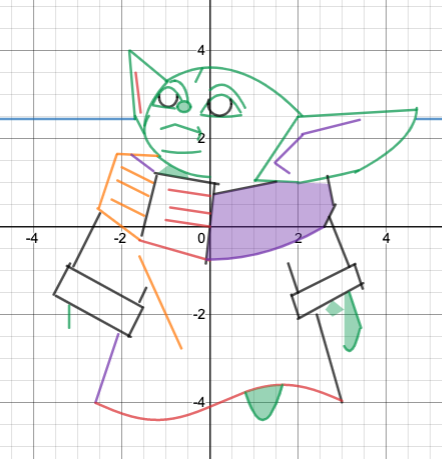
This is only the second year that I have done Conics Projects on Desmos. (Click
here for previous Conics Desmos Project post). This year, I taught conic sections in the first semester, and so I assigned this before Thanksgiving break in case students wanted to work on it. They did a fantastic job!
I think this project is great for several reasons, but mainly:
- It's open-ended
- They really learn about domain restrictions and intersections
- They can use conic sections as well as parent functions, so it ties concepts together
- They can relate math to something they enjoy
- It's creative
- They researched things I haven't taught them yet: inequalities, trig graphs, and lemniscates, for example
This year I added a peer review. I got the idea from my graduate class in Applied Learning. Each student was assigned a peer, and they had to say something that they liked about the project and something that they thought could be improved. They had to send this to me, and then I sent it to the peer, which ensured good quality and no negative comments. Then, the students had to make a change based on their peer's recommendation. Honestly, they gave better critical feedback than I ever could have! (See below for more info on the peer review).
Here are some of their projects.
Examples of how the Final Project was turned in:

Peer Review:
How I set up the peer review. Each student sent their project to the person after the arrow. The person after the arrow then sent their response to me, which I read and then forwarded to the student.
Cristi
->Will -> James->Manci-> He ->Lucas ->Bobby
->Grace ->Irina-> Leo->dylan
->zach ->andres ->anthony
-> niamh ->ella ->ashley ->zhongxuan ->
blake
->jack ->cristi
A Great Peer Review
Here is my Rubric.
RUBRIC 30 POINTS
TOTAL
_____ 4 points Creativity
_____ 3 points Colorful
_____ 5 points Sophistication of conics
_____ 4 points Use of domain restrictions
_____ 5 points Final project with all conics shown
prominently is printed in color do not
wait till the last minute to do this, nor have poor printer quality and
pasted on construction paper
_____ 4 points Equations printed out and pasted next to
picture on construction paper (can go off the
page if
necessary.)
______5 peer review turned in on time (-2 if late per day)
(graded separately – not part of 30 points)
______5 peer review emailed to me (graded separately - not
part of 30 points)
______5 corrections based on peer review
How this project related to my Doctoral study in the Applied Learning Sciences
(Excerpt from my paper)
I believe that the way I teach is an amalgamation of several learning
theories: Piaget’s constructivism, Papert’s constructionism, Vygotsky’s social
constructivism, and even Behaviorialist theory, when I need to get facts across
quickly. However, with my learning project, I am going to focus on Papert’s
Constructionism, where “learners make
knowledge their own,” (Kafai, 2006 p. 39) and physical objects are important.
Using ideas gleaned from Piaget when he worked with him in Geneva, Seymour Papert
found it was possible to learn abstract concepts concretely through
objects-to-think-with. The objects my students will think with are graphs of
conic sections. As of this writing, my students are learning how to graph and
find equations of conics, yet I believe that they do not quite have ownership
of the concept. It is something they know they need to study to pass the
course, but I think that the topic is abstract and separate from them. Through
the creative drawing activity, students will be transforming the ideas taught
in the classroom and will express them through the website Desmos.com. Similar
to LOGO, students will create designs of their choosing by “telling” the
computer what to do; in this case, entering equations and playing with them
until they are in the “correct spot,” that is, getting it out of their heads
and onto paper. Every student can (and is encouraged to) relate conics to
something that they enjoy, for example: create a beach scene, a zoo, a hockey
arena, or a videogame scene, for example. The hope is that they will appropriate
their knowledge to make it their own (Kafia, 2006).
Kafai, Y. B. (2006).
Constructionism. In R. K. Sawyer (Ed.), The Cambridge handbook of the
learning sciences (1st ed.) (pp. 35–46). Cambridge, England: Cambridge
University Press.